
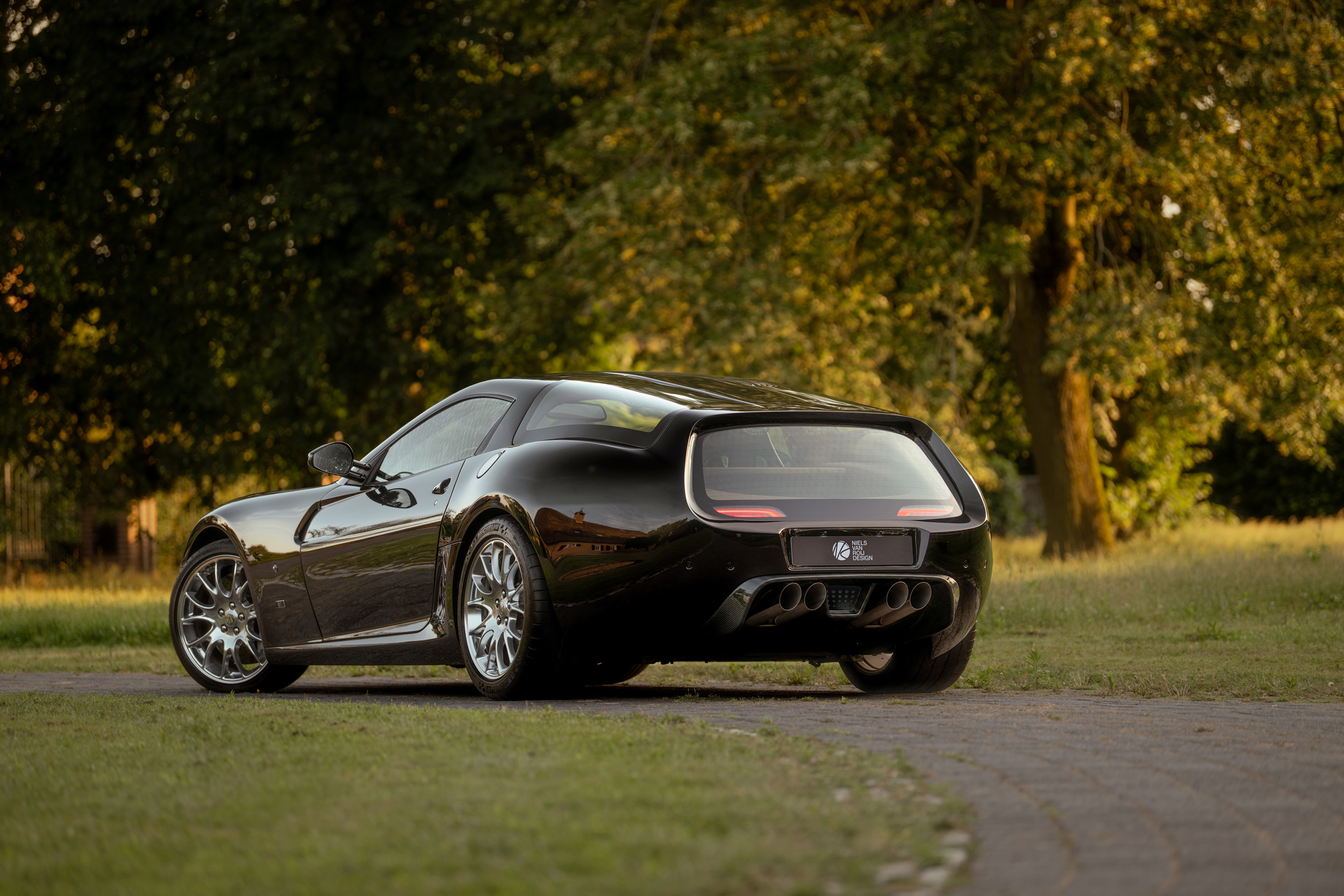
In 1972, Luigi Chinetti Jr., Ferrari’s U.S. importer, commissioned a one-off shooting brake based on the 365 GTB/4 Daytona. Chinetti customer Bob Gittleman wanted something unique, and, with the aid of American designer Gene Garfinkle and Britain’s Panther Westwinds coachworks, he certainly got it.
It was a striking vehicle, with a speedboat-like nose, complete with decorative wraparound orange trim, and an extended roofline that included a pair of glass butterfly wings that opened to access the luggage area. A single piece of vertical, trapezoidal glass reminiscent of the 1961 250 GT Breadvan finished the rear.

A standout design then, but that doesn’t mean it was perfect, notes Niels van Roij, as he reveals his modern interpretation of the car—the Daytona Shooting Brake Hommage. “It has its flaws from an aesthetic point of view, which is totally understandable as we’ve moved on since the ’70s. The wheelbase is a bit too short, over on the nose it’s a bit too long, and it looks a bit weak from certain angles.”
Van Roij was given the opportunity to re-imagine the Daytona Shooting Brake thanks to a fellow Dutch customer. “Like all of the clients, he’s a real driver, so he enjoys taking a car out and using it, and did not want to build a trailer queen, but a car that’s useful to go from A to B. He was looking for something that would be a bit more suitable for Grand Touring, but the main idea was that he likes that ’72 Daytona.”
They quickly agreed on a Ferrari 599 GTB as the donor car, as “it just works very well with the overall aesthetics, placement of the wheels, dash-to-axle ratio, all these things are quite comparable,” says van Roij.


The client even went as far as sending van Roij a rudimentary mock-up of what he wanted. “It started with a photo that he made. He had a side view of a black 599 and a side view photo of the Daytona Shooting Brake, and he cut out the butterfly windows, put them on the photo of the 599, and he sent it to me over WhatsApp. He’s been very involved and very keen on co-creating, which is again something we are keen on too.”
Even before a final design had been agreed upon, van Roij’s team had stripped the 599 of all bodywork, keeping only the doors and windscreen. “It’s blind trust, if I’m really honest,” he confesses, “that this is going to be all right in a couple of years’ time, but for the longest period of time, it’s not all right, because that car is completely apart.”
In the case of the Daytona Shooting Brake Hommage, it took a very long time indeed for the car to reach the stage where it was presentable—over five years. That’s partly due to the client pausing the project, but also down to its complexity. Van Roij reckons more than 15,000 hours of work has gone into the design and build to date—and it’s still a couple of months away from delivery.
For van Roij, the goal was to evoke the essence of the 1972 original, but not to directly imitate. “There’s this push and pull of how far can we get away from the ’72 design team before we lose it, and how close can we get to it before it starts to be a copy, because we don’t want to make a copy, he says. “We want to make an original piece of car design, so one of the main core goals was to make sure the whole design was more a complete sculpture.”

“It was key that we made it as calm as possible and not just add features because they look cool. For instance, that typical ochre (at the front). It’s not really a headlight in the ’72 car, it’s just a piece of plastic, actually held in with screws on the outside. But it looks like a headlight, and we wanted to do something with that. Rather than making it like an actual lighting unit, we wanted to make it way more sculptural, so we’ve made it into a wing that goes over and under the headlight units.” He went on to add that the overhangs of the ’72 car are way too big, especially from the side view, and that the angle of the butterfly windows is too straight, making the car look broken in a way. “So we translated the butterfly windows onto this car, but it has richer shoulder lines and hips at the back. It’s a very strong soft muscle around the rear wheel, and it flows into that shape of the butterfly window, which is quite different from the ’72 car.”
Van Roij walks around the car, pointing out numerous elements that combine to create a more cohesive design, from the way the power bulge in the hood feeds forwards into the vertical grille vanes in the nose and rearwards over the roof, creating the central hinge point for the butterfly windows. Those windows open with a theatrical flourish by remote control or from a button inside the car, by the way.

Speaking of the interior, van Roij has moved the instrument panel to the center of the dash to echo the ’72 car, but hasn’t slavishly copied its cabin. Polished wood was deemed too much of a throwback, so there are visual carbon-fiber elements alongside the acres of tan leather.


Mechanically, the 599’s entire chassis and powertrain are carried over without modification, including the F1 transmission, as that’s what came with the donor car. A manual conversion was only briefly considered, as van Roij says the owner plans to daily drive it.
If you think that’s just marketing, think again. As we’re talking, van Roij gets word that the owner of his previous Breadvan Hommage is stuck in France with a puncture and won’t make it in time for us to see the two cars together. The drive from Germany is nearly 800 miles.
Meanwhile, four-time IndyCar champ Dario Franchitti regularly uses his Silver Spectre Shooting Brake that van Roij built on the bones of a Rolls-Royce Wraith.
Expect the Daytona Shooting Brake Hommage to start piling on the miles just as soon as its owner gets the keys.


The post Meet the Modern-Day Daytona Shooting Brake appeared first on Hagerty Media.
Related Posts
The End of the Era: 1971 Pontiac Grand Prix
The 1969 Pontiac Grand Prix set the template for personal…
RUF Enters the Ring with a Heavyweight Boxer
Few venues are more appropriate for wild supercar debuts than…

There’s a City in Asia with All-White Cars
Can you imagine being restricted from owning a vehicle in…