
In a vacant grass lot behind the Jefferson County Sheriff’s Office, a second-gen Honda CR-V revs its engine in the afternoon sun. The ear-splitting tones easily crack 115 decibels. Wha-POW, wha-POW, wha-POW, wha-POW!
The 2.4-liter four-banger pops off the rev limiter, its straight-piped exhaust protruding through a few holes haphazardly cut into the hood. The racket echoes off a half dozen hulking roll-off dumpsters surrounding it, amplifying it for the unfortunate bystanders.
“F*@# that guy,” Tate Morgan, the founder of the Gambler 500, says with a chuckle. “I had to talk to him six or seven times yesterday.”
Directly in front of Morgan and me is a black John Deere backhoe, its operator gleefully tearing apart an abandoned trailer that had been dragged off public land here into Gambler Town to be disposed of. The black claws tear indiscriminate chunks of the roof and walls and effortlessly toss them into one of the dumpsters. The previous occupants’ belongings spill out onto the ground—bedding, clothing, a child’s toy truck.
“It’s good we’re down wind of that,” Morgan nods toward the quickly disappearing trailer.

Though Morgan rolled up to me on an aging scooter designed for Japanese commuters and grocery-store runs, he is an imposing figure. About six-and-a-half feet tall with a graying beard, a mohawk-style mullet, and draped in a black-and-white custom “Gambler 500” poncho, he looks as if Tyler Durden and Dax Shepard had a brother.
Looks can be deceiving. Beneath Morgan’s burly exterior lurks a gentler side—at least, there must be. You don’t spend the good part of a decade turning an off-road rally for crappy cars into the most successful trash-collecting effort in the world if you don’t have a big heart.

Since 2018, the Gambler 500 and its sister organization, Sons of Smokey, have removed 5.5 million pounds of trash from public lands. “More than any other organization on the face of the planet,” Morgan says.
If you’re surprised by that fact, so was I. Now in its tenth year, the Gambler 500, internationally infamous for hooliganism and outright bedlam, has changed a lot in the last decade. I attended the first three public Gambler 500 events, starting in 2017 (a few events beforehand were private, just Morgan and his friends). But I’d not been back since 2019. And I’d left the event with something of a sour taste in my mouth, certain that it had jumped the shark.
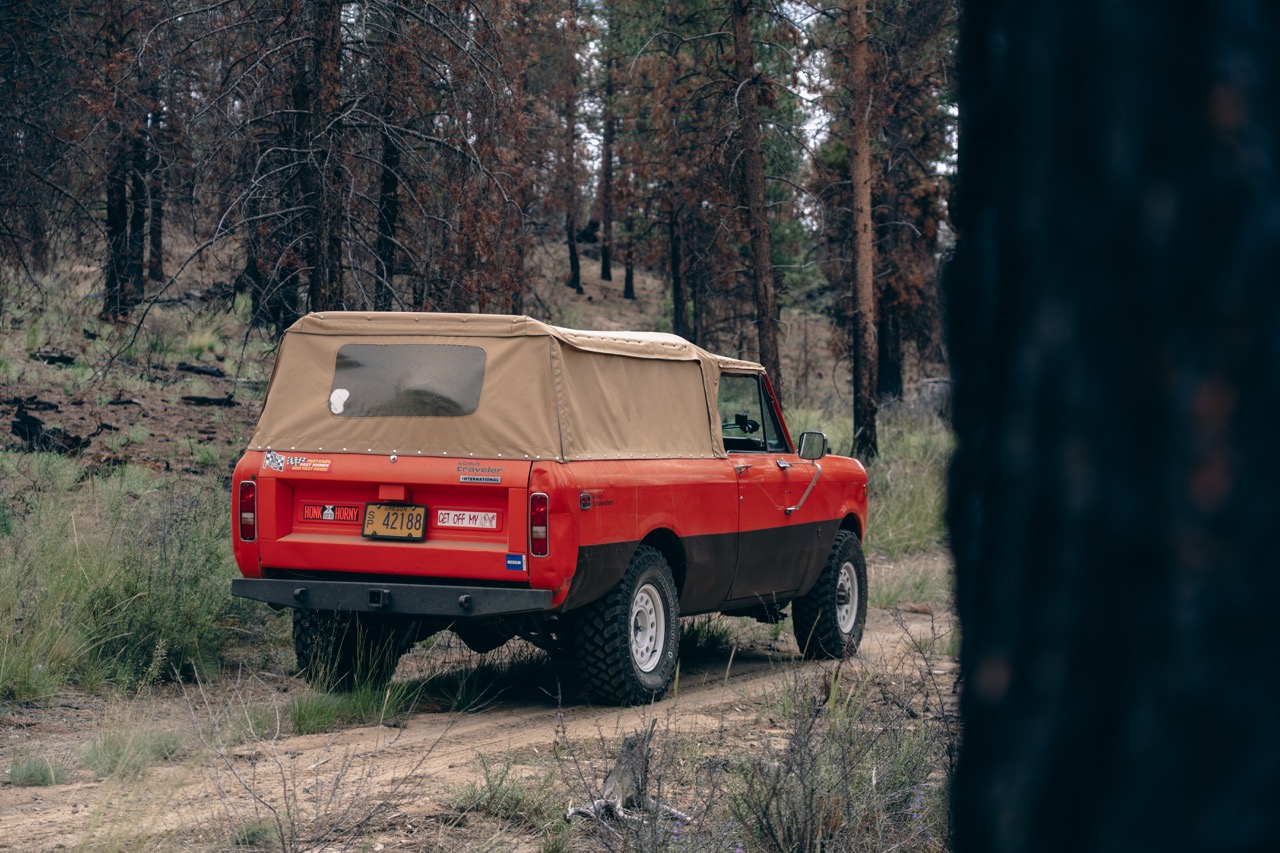
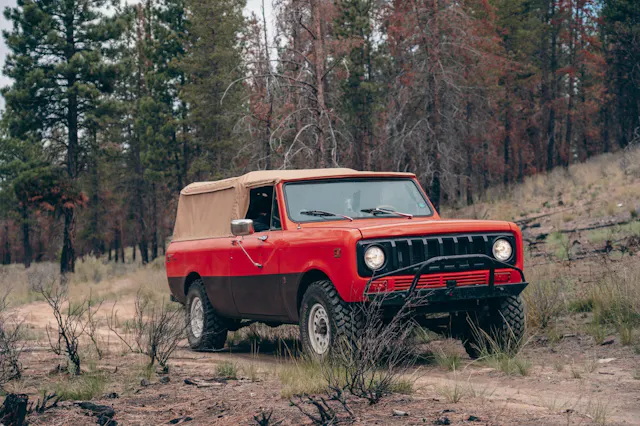
Keen to reacquaint myself with the Gambler, my buddy Willy and I, accompanied by my dogs, Arlo and Rocco, loaded our camping gear into my ’76 International Scout Traveler, the Gamblin’est rig I have, and headed southeast from Portland toward Madras.
Sugar High, Devil-Bound


Due to a medication I am currently taking, I can’t consume dairy. It really throws off my milk-heavy breakfast diet. So, the Friday morning of the Gambler 500, I had half a bag of watermelon gummy candies and a cup of black coffee for breakfast—an embarrassing most important meal of the day for any self-respecting 41-year-old. On the Gambler, though, it felt oddly fitting. Cranked up on sugar and caffeine, I gleefully throttled the Traveler’s 345 V-8 up Oregon Highway 26, over Mt. Hood toward our first waypoint.
Morgan offers three routes for Gamblers: “Madras Meander (short),” “Tumalo Pipeline (pop down to Bend and say hi),” and “The Devil’s Butthole (‘it’s a long way to the top if you wanna rock and roll’).” Willy and I chose to rock and roll.
In years past, the highlight of the Gambler was the mob of wacky cars exploring Oregon’s backcountry and fire roads. These ostensibly $500 machines ostensibly covered 500 miles, but the routes were unofficial, so Morgan never really leaned into the specifics. In the event’s first few iterations, no matter which route you chose, you’d find it teeming with Gamblers ready to party.

I’d run previous Gamblers with a group of friends, but this year it was just Willy and the dogs and me. We were certain we’d encounter a merry group of Gamblers on the way and make some fast friends. As we hung a left off Highway 97 out of La Pine toward Hole in the Ground, however, I had a realization: We hadn’t seen any other Gamblers since we passed through Madras 90 minutes ago.
Around 6 o’clock that evening, 15 miles down the dirt two-track east of La Pine, the temperature began to drop. An unseasonable late-June cold front was settling in the area. Willy and I decided to set up camp and resume our Gambler search in the morning.
Sons of Smokey

Once we’d made camp, the dogs piled out of the truck and ran amok in the dirt after having been cooped up in the Traveler all day. Willy threw on some coats and thumbed open the Sons of Smokey app on a single bar of signal. It’s a free app that anyone can use, created in response to the myriad systems that private and public agencies and organizations were using for tracking illegally dumped garbage and abandoned vehicles.
With it, anyone can tag the location of rubbish in need of removal on public land. You can add info like type of garbage, size, and how big a vehicle will be needed to remove it. And with the app, anyone can navigate to that site and snag it. This is the engine that drives the Gambler 500’s trash-collecting and disposal efforts each year.
It’s no longer just hobbyists using the Sons of Smokey app, either. The Bureau of Land Management in Utah now uses it to manage dump sites across the land it oversees, and the Forest Service, which once eyed the Gambler warily, now sends rangers, Smokey Bear, and crews to work the cleanups alongside it. The app is free on iOS and Android, and getting it into more hands is the one thing Morgan asked me to pass along.
He started Sons of Smokey informally back in 2017, but he didn’t formalize it as a 501(c)(3) until 2021, when Ford came knocking. The mission is narrow on purpose: get trash off public land—not just litter, but the abandoned cars, RVs, and boats that the Forest Service and BLM simply don’t have the staff or budget to haul out.

For his part, Morgan refuses to put a single person on payroll, himself included. As he sees it, the moment you’re paying salaries, you’re no longer fundraising to clean up trash; you’re fundraising to make sure the staff keeps getting paid. He’d rather the gas-station clerk who buys a Sons of Smokey hat knows that his money goes straight to disposal fees, not to somebody’s Starbucks order. It’s the kind of stubbornness that makes for a lousy business plan and a hell of a nonprofit.
So, the org stays deliberately lean: Individual donations and grants—like the Bronco Wild Fund money that covered much of last year’s haul—go almost entirely to the dump bill, which is the real expense. Corporate dollars come, too, but Morgan takes them warily, because they tend to arrive shrink-wrapped in marketing activations that are more about talking up the cleanup than actually doing it.
There’s a philosophy underneath all of it, too. Tate Morgan has worked to keep the Gambler a big tent, pushing back on the flag-waving, macho strain of car culture he watched creep into the event’s early years. “I don’t wear my politics on my shoulder,” he told me. Picking up trash, the way he sees it, is something anyone who uses public land can get behind, regardless of who they voted for. It’s stewardship as common ground.
Older and Wiser
The Gambler 500 is always held Friday to Sunday during an early summer weekend in Central Oregon. The dates change from year to year, and so does the main event location.
In 2017, the staging area, Gambler Town, was in the parking lot of Hoodoo Ski Area Mt., about 140 miles southeast of Portland. For 2018–19, Gambler Town was in a pumice pit outside of tiny Chemult. If the word “pumice” conjures images of dust clouds in your mind, you’re on the right track. Just take whatever you’re picturing and double it.
This year, due to elevated drought-driven fire risk, Morgan intended to move the event from Madras toward Christmas Valley. “You can’t set sand on fire,” he says.
But when word spread of the Gambler’s departure, Madras officials and the Forest Service asked Morgan to stay. The event is a windfall for whichever town hosts it; in the Chemult years, Morgan says, it brought an estimated $1.1 million in extra weekend spending to the local economy. The elevated fire risk of 1500 hoopties driving around the grasslands was worth the economic boon to the region. So, they gave Morgan the keys to the grass fields behind the Sheriff’s Office and increased Forest Service fire personnel for the weekend, including a helicopter.
This year’s Gambler Town was smaller and more sedate than the last time I attended. That melee was more like “Mad Max” meets “Jackass” meets a pirate raid. Save the aforementioned throttle-happy CR-V–driving chucklehead, this was a quieter place than in years past. We Gamblers are 10 years older than we were during the first event, and that maturity was mostly reflected in the way the attendees comported themselves.
Morgan admits that turnout isn’t what it was during the pumice-pit era, which peaked at 8000 attendees. “Year-over-year growth is the logic of cancer,” Morgan says, justifying the smaller numbers at Gambler Town with a shrug.
Returning to Town


On Saturday morning, Willy and I returned to the Devil’s Butthole track keen to find some Gamblers in the wild. By lunchtime, we had found none. We gave up the search, turned around, and headed north toward Gambler Town. We didn’t see any other Gamblers until just a few miles south of Madras—a stark contrast to past years, when the whole region was teeming with hoopties.
We weren’t in Gambler Town more than a few minutes before Morgan rolled up to me on his scooter. It was as if his centurions at the gate alerted him to my arrival. I remarked how few Gamblers we saw outside of the Madras region. The majority of folks were out in the grasslands, collecting trash, he said.
Willy and I stood near the front gates and watched as Gamblers returned to drop off the trash they’d collected during the day. It was a constant flow of lifted, straight-piped Panther-platform Fords and domestic economy hatchbacks with intentionally misspelled slogans and slurs scrawled across the bodywork in spray paint. The juxtaposition of what my eyes saw, a bunch of filthy hooligans in pirate cars, and what I knew they were doing, each unloading hundreds of pounds of trash they’d spent their weekend collecting on public land, almost made me lightheaded.
What started in 2017 as a 500-mile off-road race for $500 cars culminating with a seething all-night party that would make the devil himself pray for earplugs had become a weekend-long exercise in improving public land, accented with a parade of slipshod jalopies.

Ten years ago, Morgan unwittingly tapped into a vein of wanton destruction that had been dormant in Gen-Xers and millennials since Woodstock ’99. Over the last decade, he’s accomplished the impossible: Rather than use his Gambler army for evil—he could have very well become a Bane-like supervillain—he harnessed it for good.
Following my last entry in the event, I publicly criticized the Gambler 500 (and, through transitive property, Tate Morgan) for losing the thread and becoming an excuse to sell merch. Attending this year was my way of finding out if I was right or wrong.
So, is the Gambler 500 like it used to be? No, it’s not. It’s not as populated, and it’s not as raucous. From the ashes of the superficial original Gambler 500 has risen something much bigger, more important.
The world has changed, too. Morgan admits there are no $500 cars anymore, and even being able to afford to buy and modify a crappy car for a weekend event is a luxury. So, he welcomes with open arms folks in their daily drivers, so long as they show up to the gates of Gambler Town with a shovel, a fire extinguisher, five gallons of water, and a load of trash.
“You were the first and only person to ever be mean to me,” Morgan tells me. “Everyone else… I just get attaboys constantly. So, it was refreshing to have some hate.”
For the record, Tate, it wasn’t hate: It was my misunderstanding. I didn’t quite see what you were up to. So, consider this a correction. What you have now built in Sons of Smokey and the Gambler 500 is truly impressive. I regret the error.
The post A Gambler 500 Mea Culpa appeared first on Hagerty Media.
Related Posts
Against All Oddities: Eagle Has Landed
My first Hagerty column, published in March of 2019, was…
AutoHunter Spotlight: 1950 Chevrolet Styleline Deluxe Coupe
When new in 1950, the Chevrolet Styleline was important because…
AutoHunter Spotlight: 1977 Pontiac Firebird Formula
The 1977 model year brought several changes to the Pontiac…